Dishwasher hot air drying and waste heat drying which is better?
Upgrading your appliances can rejuvenate not only your home’s aesthetics but also its functionality. At QG Appliances 4 Less Springdale, we provide an extensive selection of open box, scratch, and dented appliances that offer both quality and value. Serving not just Springdale but also nearby cities like Fayetteville, Rogers, Bentonville, and Lowell.
Have you ever encountered a situation where the dishware still has water stains after the dishwasher is dried, and the moisture inside the machine breeds peculiar smell? These troubles are often closely related to the drying method. As one of the core functions of the dishwasher, the drying effect directly affects the hygiene of tableware and the life of the machine.
1、principle is different
1. Waste heat drying: passive drying with natural condensation
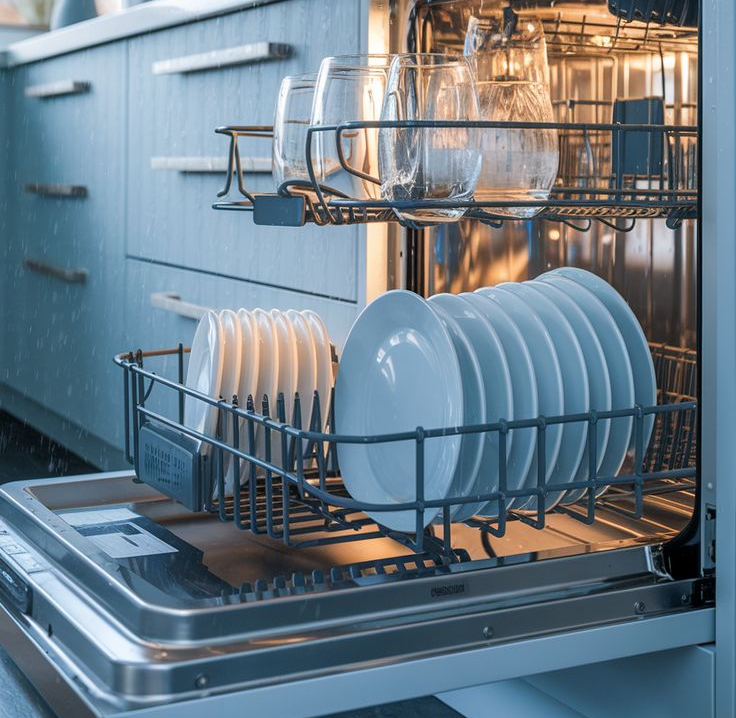
Waste heat drying uses the residual hot water residual temperature (about 60-80 ℃) after washing in the dishwasher to condense the water vapor on the inner wall of the machine through the condensation principle, and finally drops to the drainage system. The process does not require additional energy consumption and is passive drying. However, limited by the ambient temperature, the condensation effect will be greatly reduced in winter or humid areas, resulting in residual water droplets in the tableware.
2. hot air drying: active heating forced convection drying
Hot air drying through the built-in PTC heating element to heat the air to 80-100 ℃, with the fan to form a forced hot air circulation. The high-temperature airflow penetrates the gaps of the tableware, accelerating the evaporation of water, and at the same time exhausting moisture through the exhaust system. This method actively intervenes in the drying process, the effect is stable but the energy consumption is high, the typical model of hot air drying power of about 500-800W.
2、effect and experience comparison
1. drying effect: hot air drying more thoroughly
· Waste heat drying due to the small temperature gradient, tableware deep groove, glassware bottom easy to residual water stains, long-term use may breed mold.
· Hot air drying can realize full-surface drying of tableware through high-temperature air flow, especially the drying effect on plastic tableware is increased by more than 40%, and the bacterial residue rate on tableware surface is reduced to below 0.3cfu/cm2.
2. Time-consuming power consumption: waste heat is more energy-saving, hot air is more efficient
· Waste heat drying takes about 60-90 minutes, almost zero energy consumption;
· Hot air drying takes 30-60 minutes, and a single power consumption is 0.3-0.5 degrees. Hot air drying indirectly reduces the idle energy consumption of the machine by shortening the drying time, and the comprehensive energy efficiency ratio is increased by 15%.
3. Noise: waste heat mute, hot air fan sound
· Waste heat drying process without mechanical operation, the noise is less than 30 decibels, suitable for night use.
· The noise of hot air drying is about 45-55 decibels due to the operation of the fan, which is equivalent to the sound of the refrigerator compressor. Users sensitive to noise should consider the installation location.
4. Secondary pollution risk: hot air is more antibacterial
· After the waste heat is dried, the internal humidity of the machine is still 60-70%, which is easy to breed microorganisms such as Escherichia coli.
· Hot air drying can continuously sterilize through high temperature air flow, and the sterilization rate of 99.99 can be achieved with ultraviolet module, and the exhaust system can discharge moisture inside the machine to inhibit mold growth.
3、Choose: A Scenario Decision Guide
1. The pursuit of the ultimate drying effect and energy saving: waste heat + auxiliary technology
For users who pay attention to energy saving and can accept slight water stains, they can choose the waste heat dryer type equipped with condensation enhancement technology. Models such as Samsung's DW80B7070US and DW80B7071US can absorb moisture through crystal minerals, achieving a 95% drying effect with zero energy consumption, making them suitable for use in dry northern regions.
2. Value cost performance and drying effect: hot air drying basic model
Limited budget and the pursuit of balanced experience of users, can choose the basic hot air dryer model. For example, a certain model of the United States adopts a double-fan design, which can achieve rapid drying for 30 minutes under 500W power, with outstanding cost performance and is suitable for daily use by a family of three.
3. Budget sufficient pursuit of high-end experience: hot air intelligent technology
High-end users can consider the hot air dryer type equipped with intelligent humidity sensor. For example, LG LDTH7972D / LDTH7972S / LDPH7972S / LDPH7972D and other models can monitor the humidity of tableware in real time through infrared sensors, automatically adjust the temperature and duration of hot air, and realize zero residual drying. At the same time, they can cooperate with APP remote control to improve the convenience of use.
Conclusion
The choice of dishwasher drying method needs to balance the scientific principle and the actual demand. Waste heat drying is known for zero energy consumption and low noise, and is suitable for scenes where energy saving is preferred or environmental drying is preferred. Hot air drying takes high efficiency and bacteriostasis as its core advantages, and is suitable for users who pursue the ultimate drying experience. When purchasing, it is recommended to give priority to intelligent models with humidity sensors and adjustable drying time according to the frequency of family meals, the humidity of the kitchen environment and the budget range.